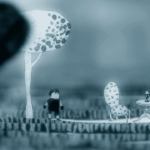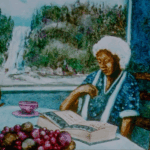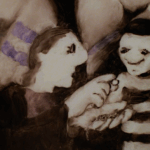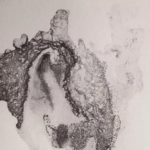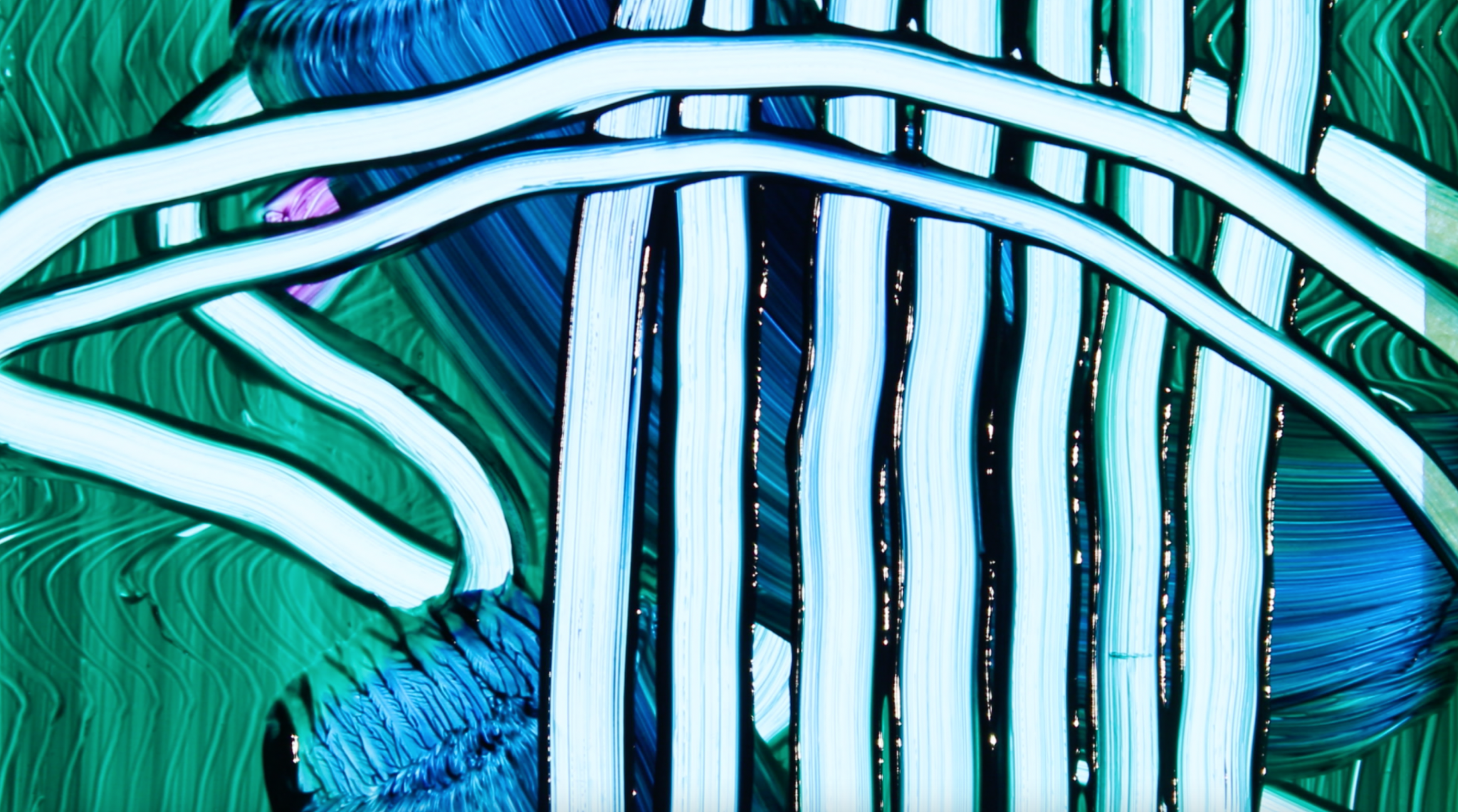
A still of a combined cameraless and paint-on-glass animation method
Animating paint on glass through a direct animation method
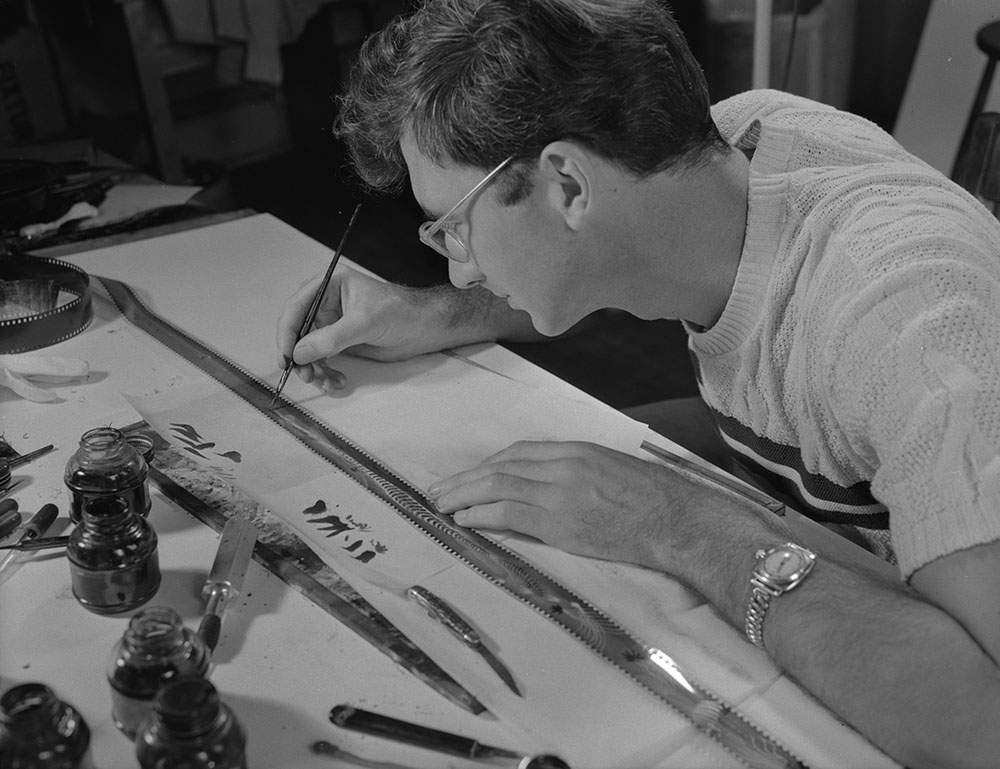
Celluloid was the first canvas for the mass-reproduction of moving images and the basis of analogue film. Its invention industrialized projection and established film as a modern medium. Although most analogue film was based in photographic recording, alternative practices subserted this expected use. Cameraless (also known as “direct”) animation was one such technique, which used film strips as long, vertical canvases for direct, painterly markmaking. Rather than using film to reproduce images, it synthesizes images directly on the material. In the mid-20th century, animators like Len Lye and Norman McLaren used the method to abstract figure and sound through celluloid. Working with the Animate Materials Workshop, research assistant Marina Levit experimented with reproducing the methods and effects of direct animation using glass and acetate instead of film, drawing on their background as a trained painter. Their modification of cameraless animation raises the question: as analogue industrial practices meet digital technologies, how does the legacy of filmic material innovation continue to reinvent itself?
-
Norman McLaren’s behind-the-scenes production of “Begone Dull Care” (1949) and the film strips from the film.
-
Norman McLaren’s behind-the-scenes production of “Begone Dull Care” (1949) and the film strips from the film.

Celluloid’s appeal for cameraless animation lay in its qualities as a synthetic plastic: its flexibility and extended length, which made up for the narrow width of 16mm or 35mm film gauges. When illuminated by the bulb of a projector, direct animation films cast brilliant, saturated images onto the screen. When contemporary filmmakers aim to replicate the technique by scanning painted celluloid on a digital flatbed scanner, they are unable to achieve the same luminosity. To simulate the effect with an animation stand equipped with a digital camera, Levit used tape to separate a glass pane into long, thin sections that imitate the shape of celluloid film. These lengths were far shorter than a film roll, but they carried an advantage of their own: where the width of film is fixed, taped glass can be adjusted. Levit could choose whatever size and aspect ratio was most convenient to work in and mark out divisions for individual frames. The set-up created possibilities of layering more than one panel, as with a multiplane stand, as well as combining sequences from different panels into varying combinations.
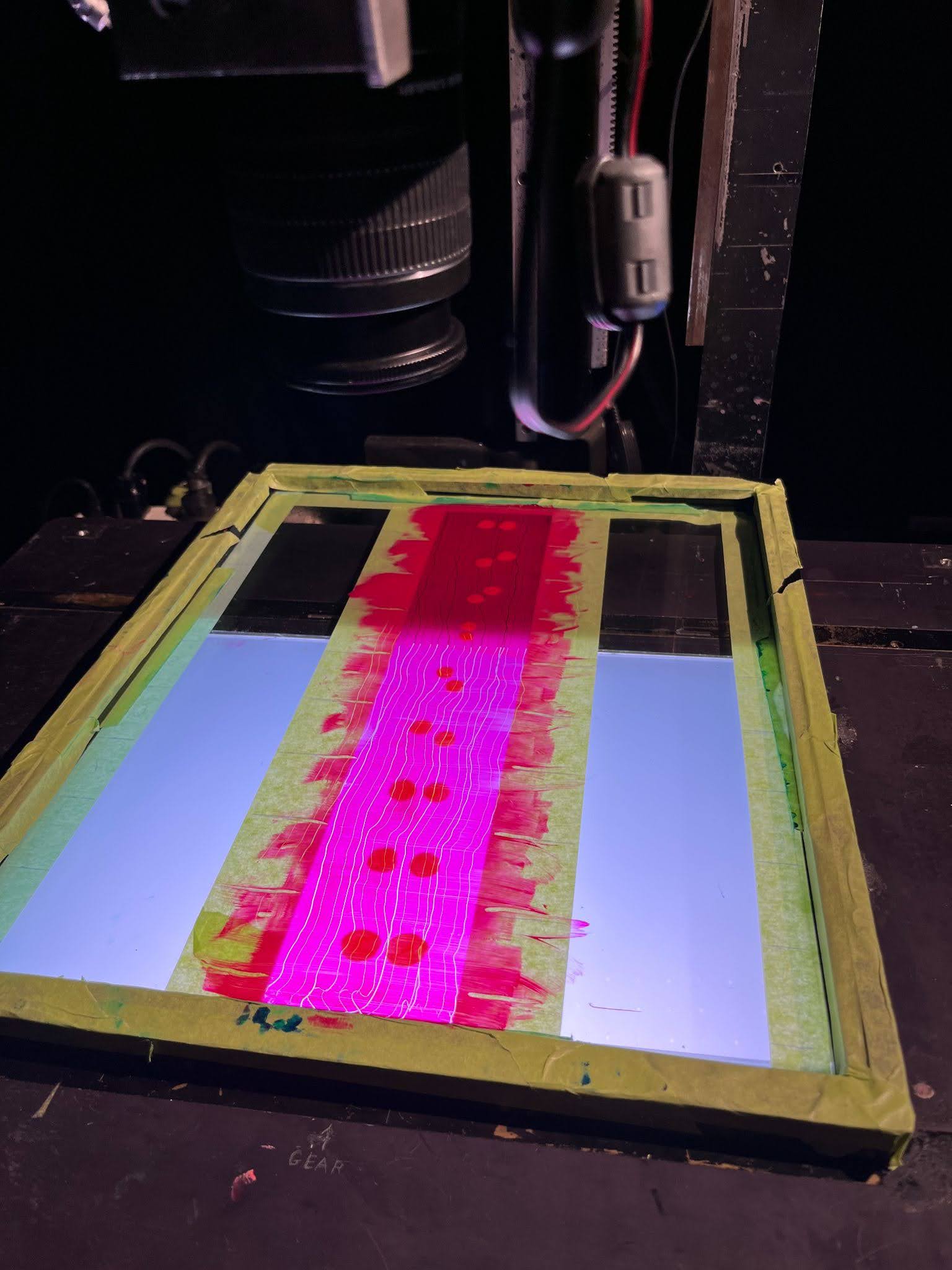
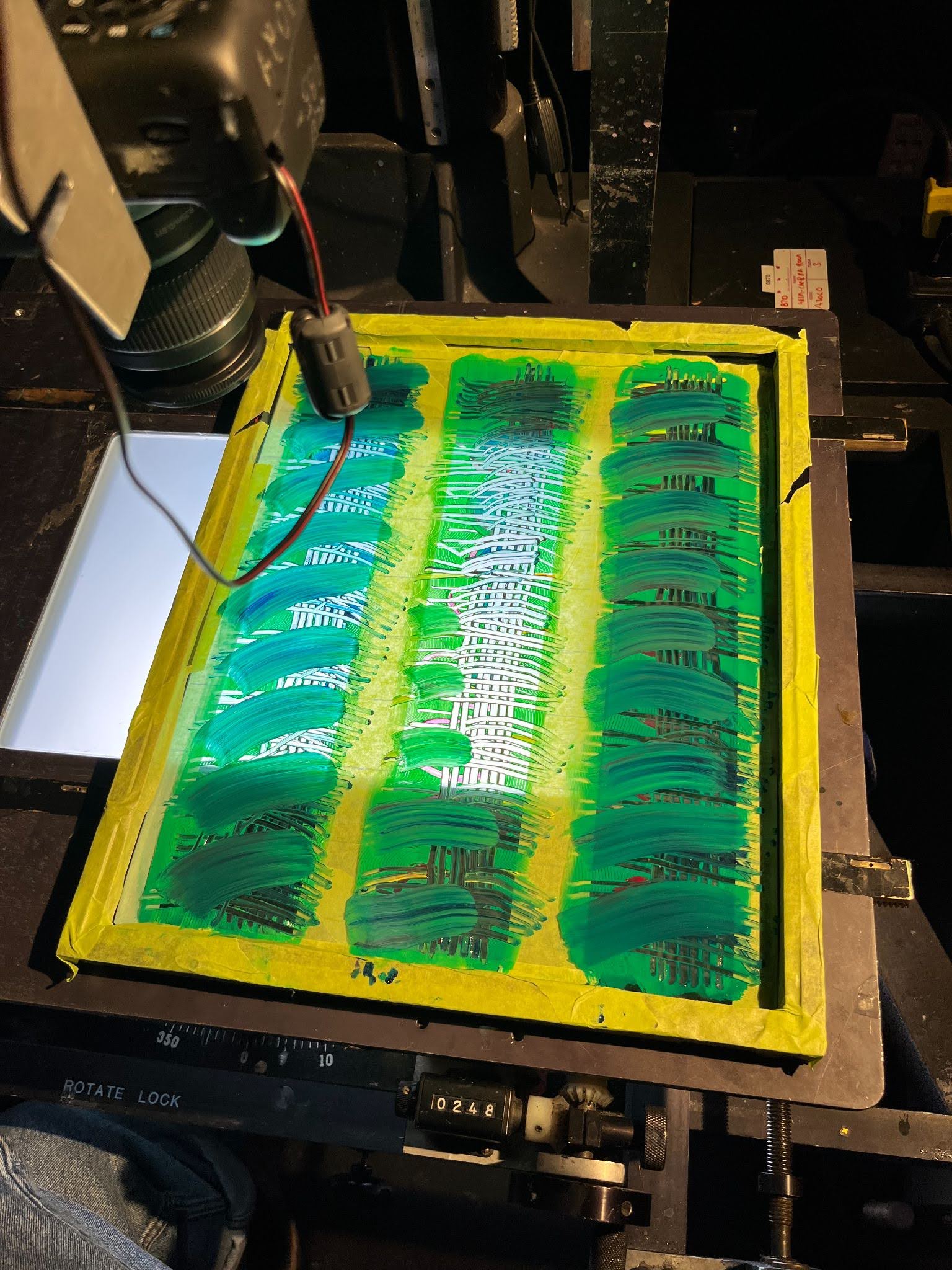
Sectioned-off glass to imitate film strips for a cameraless animation format
Before exploring the potential of this technique, Levit first practiced paint-on-glass animation to understand how the properties of glass affect the perception of paint chroma, value, and hue. Working with a single glass panel helped Levit understand how paint behaves under the camera, as well as how colour pigment registers with an underlight. The method of paint-on-glass animation requires paint to stay wet, as it is moved with brushes or other tools with each subsequent frame. Only what is moved needs to be repainted, whereas areas that remain the same are held still. The overall composition holds somewhere between movement and stillness. Levit found the visible strokes and smudges in this animation sequence compelling. The animated imperfections read as a sign of change rather than sloppiness. Managing multiple layers proved difficult, but the test clarified how to work with the multiplane and several pigments at once. Practicing at this larger scale made the smaller, sectioned-off portions of glass feel straightforward by comparison.
-
Behind-the-scene of Levit’s paint-on-glass work on the multiplane
-
Behind-the-scene of Levit’s paint-on-glass work on the multiplane
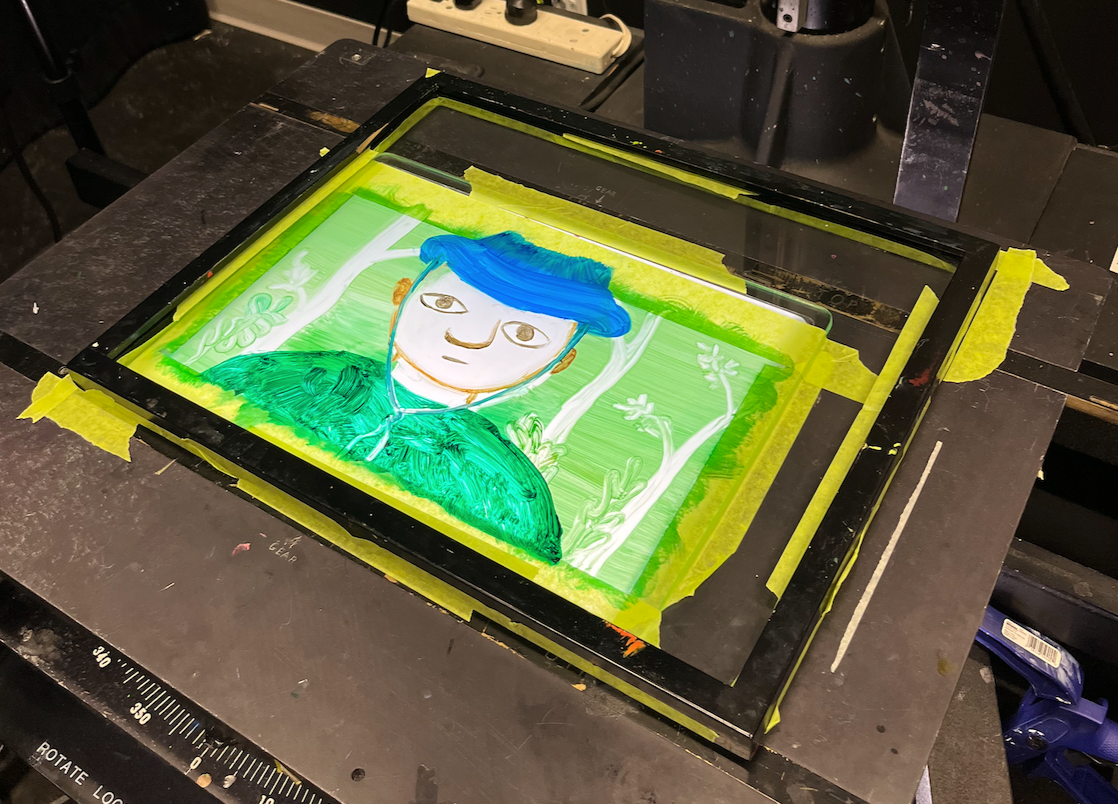
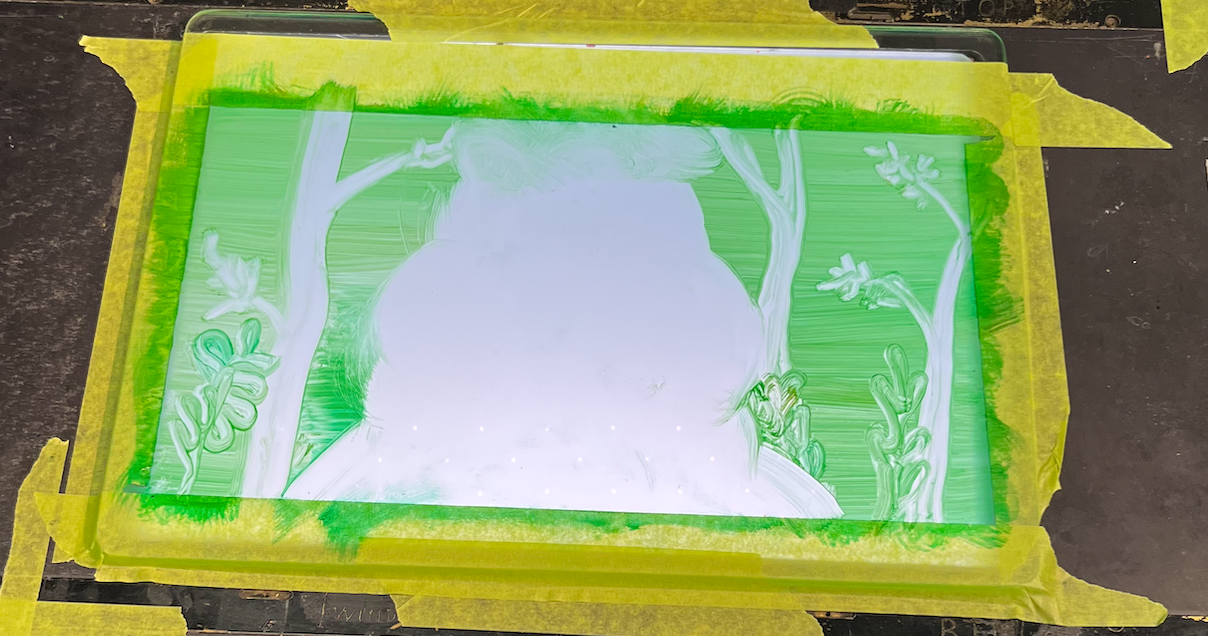
An early example of Levit’s paint-on-glass animation using the multiplane
Levit’s first test with a simulated direct animation method focused on trying out various tools for manipulating paint on glass strips. The resulting animation is made up of roughly 12 repeating loops, each one adjusted from the previous. The composition begins with phthalo green pigment hashed vertically with a comb across the length of the canvas, which turns into dancing waves when photographed according to the segmented and marked framelines. Gradually, an opera-pink circle appears and disappears, marking each successive cycle. As the animation continues, Levit adds strokes of new colour or pushes paint aside to reveal the glowing glass surface. Levit was particularly struck by the effects of using a Q-tip, whose dense cotton drove up paint along the edges of a swipe, so that its opacity created a darker contour. Effects like these carry seamlessly between frames because of the long, vertical canvas: the film strip-like surface allows a continuation of pattern that would be difficult to animate frame-by-frame.
The first animation test combining analog animation techniques, focusing on adjusted looping and texture
The animator Len Lye would paint on both sides of the celluloid, since the translucency of the material could allow pigment to shine through both layers. Imitating this method, Levit attempted to paint on both sides of their glass strips. This allowed for one looping cycle of drawings and one evolving cycle to play simultaneously. By leaving one side of the glass unchanged between subsequent repetitions, a background rhythm could be established like a musical beat. In the animation sequence below, the two reddish dots reset every 18 frames and start again, preserving a consistent flow that heightens an evolving pink canvas in the foreground. Building on insights from their previous test, Levit simplified the composition and worked with fewer frames at a time. The animated forms were created by subtracting paint from the pink sections with forks, combs, brushes, and fingertips, to reveal and hide the percussive back-painting on the reverse side of the glass. Unlike cameraless animation, the material quality of paint can be observed in closer detail with the tightly focused digital camera. As a trained painter experimenting with animation for the first time, Levit was able to expand and highlight different painting gestures.
The second animation test combining analog animation techniques, focusing on rhythmic layering
Levit’s hybrid method paired the flowing, gestural effects of cameraless animation with the variable sizing, control, and detail of paint-on-glass animation. Freed from the fixed gauge of 16mm or 35mm, the paint could be studied up close against the smooth, luminous surface of glass, an intimate portrait that brought out more texture and let the underlighting values shift according to pigment density. Levit’s experimentation shows that analog innovation can evolve on its own terms, independently of industrial practices. The legacy of celluloid film and direct animation can reinvent itself by working alongside a digital apparatus.
Cameraless Animation Guide
Created by Norman McLaren for the National Film Board of Canada
Read the guide
Exhibition “Celluloid. Cameraless Film” at the Schirn Kunsthalle Frankfurt Catalog
The exhibition catalogue from “Zelluloid” shown at the Schirn Kunsthalle Frankfurt, Germany in 2010, featuring cameraless animation films
Read the catalogue